The still-unsolved shooting death of an acclaimed Massachusetts Institute of Technology professor this week has sent shockwaves through the campus and the broader fusion energy research community in which he was prominent.
Nuno Loureiro taught plasma physics at the elite university and led its Plasma Science and Fusion Center. The 47-year-old was shot at his home in Brookline, Massachusetts, Monday and died at a nearby hospital the next day. His death is being investigated as a homicide.
Police have not identified a suspect in the homicide, which occurred two days after a shooting at another elite college, Brown University, in neighboring Rhode Island, left two dead and nine injured. Law enforcement is investigating possible connections between the Brown University shooting and Loureiro's homicide, sources tell CBS News.
"Nuno was not only a brilliant scientist, he was a brilliant person," colleague Dennis Whyte said in an obituary published Tuesday by MIT. "He shone a bright light as a mentor, friend, teacher, colleague and leader and was universally admired for his articulate, compassionate manner. His loss is immeasurable to our community at the PSFC, NSE and MIT, and around the entire fusion and plasma research world."
The obituary described Loureiro as "a lauded theoretical physicist and fusion scientist," whose "research addressed complex problems lurking at the center of fusion vacuum chambers and at the edges of the universe."
Sources tell CBS News that Loureiro wasn't working on anything classified, as there's no classified work being performed on campus.

MIT President Sally Kornbluth wrote in a letter to students and faculty that "in the face of this shocking loss, our hearts go out to his wife and their family and to his many devoted students, friends and colleagues."
A native of Portugal, whose résumé included stints at the Imperial College London and Princeton, Loureir "used a combination of analytical theory and state-of-the art simulations to investigate several topics in nonlinear plasma dynamics, particularly magnetic reconnection, turbulence and instabilities," according to his university biography.
His research led to widespread acclaim and prestigious awards that included the American Physical Society Thomas H. Stix Award for Outstanding Early Career Contributions to Plasma Physics Research and the Presidential Early Career Award for Scientists and Engineers.
Person of interest identified in deadly Brown University shooting
latest_posts
- 1
 Understanding climate change in America: Skepticism, dogmatism and personal experience
 - 2New portrait of the oldest-known supernova | Space photo of the day for March 27, 2026
- 3Climate engineering would alter the oceans, reshaping marine life – our new study examines each method’s risks
- 4This Week In Space podcast: Episode 187 — An Inspired Enterprise
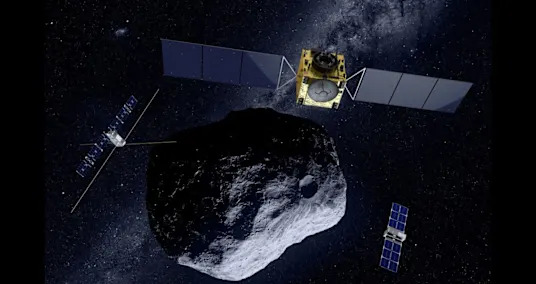
- 5Like 'accelerating from stationary to supersonic flight': Europe's Hera probe boosts speed, stays on course for November asteroid rendezvous



- Flourishing in a Cutthroat Work Market: Vocation Methodologies
- France will build a new aircraft carrier as it increases defense spending
- Kobe Bryant called this WNBA star the 'Gold Mamba.' She turned his advice to her into a tattoo.
- Watch Atlas V rocket launch its heaviest-ever payload early on April 4
- 'I was diagnosed with incurable brain cancer on holiday'
- Vacuum Cleaners That Are Not difficult To Use For Home
- How to track NASA’s Artemis II and Orion’s journey to the moon
- Virtual Domains d: A Survey of \Inundation and Ongoing interaction Mechanics\ Computer game
- Heartfelt Objections to Visit with Your Adored One