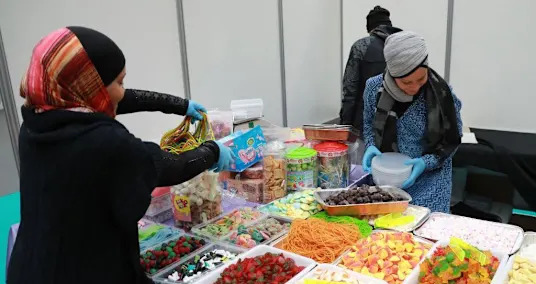
France has banned a major gathering of Muslims in the northern Paris suburbs, saying it could be a terrorist target.
The four-day Annual Encounter of Muslims of France was due to open on Friday at an exhibition centre in Le Bourget, attracting tens of thousands of people from across Europe.
But according to the Paris police department, in "an international and national context which is particularly tense" the gathering was "exposed to an important terrorist risk toward the Muslim community".
The event's organisers immediately sought an emergency injunction to allow it to go ahead, and a ruling was expected during the day.
Part cultural and religious conference, part trade fair, the Muslim gathering used to be annual, but has in fact not been held since 2019.
It is organised by the Muslims of France (MF), a group which critics say is close to the international Muslim Brotherhood.
Explaining its decision to ban, the police department said that a failed fire-bomb attack last weekend in Paris against an American bank underlined the "seriousness of the homegrown threat."
Four people, including three minors, face charges in relation to the incident, which investigators believe may have been ordered by a pro-Iran group.
The police department said that "in a context of political agitation and a heavy polarisation of debate" it was possible that "small far-right groups could mobilise with a view to disrupting the event".
It also said that actions against the gathering could be "conducted remotely by foreign influences".
France has regularly accused Russia, as well as Iran, of stirring up dissension by paying proxies to carry out small-scale acts of provocation or sabotage.
The ban came as France announced plans for a new "anti-separatism" law, aimed mainly at Muslim structures promoting ideas deemed contrary to the principles of the Republic.
Interior Minister Laurent Nuñez said the aim was to complement a previous similar law, passed five years ago, which allowed the government to close associations accused of promoting Islamic separatism.
"There are still some structures which we have been unable to reach," he told news channel BFMTV. "One issue is how we control collective childcare. We need to be able to control it, but right now we can't.
"More generally we want to be able to ban publications which carry appeals to hate, violence or discrimination," he said.
The MF's lawyer, Sefen Guez Guez, told the injunction hearing that banning the event was a "manifest breach of the right to assemble" and clearly aimed at "promoting the [government's] new law".
But a police lawyer said the sole reason was to preserve public order. "This is not an anti-Muslim or anti-Islam decree," he said.
latest_posts
- 1
 Pentagon advances Golden Dome missile defense with new Space Force contracts
 - 2Israel reports killing another senior Iranian oil official
- 3Israel's fractured opposition hands Netanyahu a full term
- 4Favored Chinese Dish: Make Your Determination
- 5Activists: Venezuela released just nine prisoners despite promise



- Nations for Rock Climbing
- Audits of 6 American Busssiness Class Flights
- AI is making spacecraft propulsion more efficient – and could even lead to nuclear-powered rockets
- There’s ‘super flu,’ COVID, RSV. Is it going around in SoCal?
- Antimatter took to the road for the very first time. Here’s why it matters
- International issues on the agenda as Frances's Macron visits China
- More loons are filling Maine's lakes with their ghostlike calls
- Advocacy groups react after Mattel introduces 1st Barbie doll with autism
- Ghassan Al-Duhaini to replace Abu Shabab as Popular Forces leader in Gaza